Project News

Home/Project News/

Alternative test strategies for nanosafety

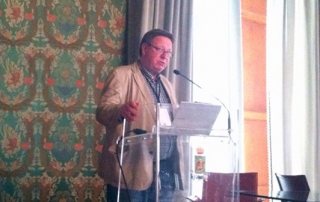
 With the advent of the next chapter of nanotechnology, there is an expectation to get more nanomaterials and nano-enabled products to  the marketplace, requiring accelerated risk assessment and the ability to make decisions that can assist the environmental health and  safety (EHS) governance of nanomaterials. We spoke to Professor Andre Nel of UCLA after his
June 9th, 2015|Latest News|

NANOSOLUTIONS Newsletter – March 2015

The latest NANOSOLUTIONS newsletter is now available. In this newsletter we have a preview of the SENN2015 congress on Safety of Engineered Nanoparticles with Professor Kai Savolainen. We have updates from WP3, WP5, WP6, WP7, WP8, WP9 and WP12, who explain some of the exciting developments from the NANSOLUTIONS project that have taken place in

April 1st, 2015|Latest News|

WP 12 – Safety Classification

Lang Tran The development and application of ENMs promises many benefits to both society and the global economy. However, to ensure responsible development of this emerging technology, governance must be put into place to ensure that any potential risk posed by ENMs are fully understood and controlled. The regulatory landscape is constantly evolving for all

November 16th, 2014|Timeline Progress|

WP11- Systems biology analysis

Dario Greco One of the main goals of the NANOSOLUTIONS consortium is to create an ENM classifier - a model that can predict the effect of any given nanomaterial. This is being done through what is known as machine learning; we are essentially training a computer programme to know what is dangerous and what is

November 16th, 2014|Timeline Progress|

WP8 – Disease Models

Fritz Krombach Inhalation of rigid multi-wall carbon nanotubes induces allergic asthma-like symptoms in mice The overall goal of WP8 is to identify the key physicochemical properties and surface modifications of engineered nanomaterials (ENM) that control their fate and biological and toxic effects in cells and tissues from susceptible individuals. For this goal, WP8 partners will

November 16th, 2014|Timeline Progress|

WP7 – Cross species models

Richard Handy A fundamental part of developing a classification system for nanomaterial safety is to identify the toxic effects that different ENMs have across a wide range of organisms, from microbes to mammals, and on different body systems. These effects are assessed by their overall magnitude of toxicity ¬– low toxicity, toxic, very toxic -

November 16th, 2014|Timeline Progress|

WP6 – Cell models

Bengt Fadeel and Lucian Farcal WP6 works on the application of in vitro methods for the assessment of nanomaterial (NM) immunotoxicity and genotoxicity. The hypothesis is that refined in vitro assays can replace in vivo testing of NMs. To achieve this goal, WP6 partners selected and refined the SOPs for the in vitro methods to

November 16th, 2014|Timeline Progress|